The place you go to think.
For the decisions, ideas, and questions that need more than a quick answer. KINVA matches you with an AI thought partner built for how you think — so you can think it through and leave with clarity that’s yours.
your match might say
“What if we lay it out — which part feels most tangled right now?”
About 5 minutes to match · Free during early access
your match might say
“What if we lay it out — which part feels most tangled right now?”
How the match happens
We don’t ask what’s wrong. We ask how you think.
Question 3 of 5
When you're stuck in your own head, what tends to help more?
Your match isn’t random, and it isn’t a personality test. It reflects how you tend to process and the kind of first move that may help right now.
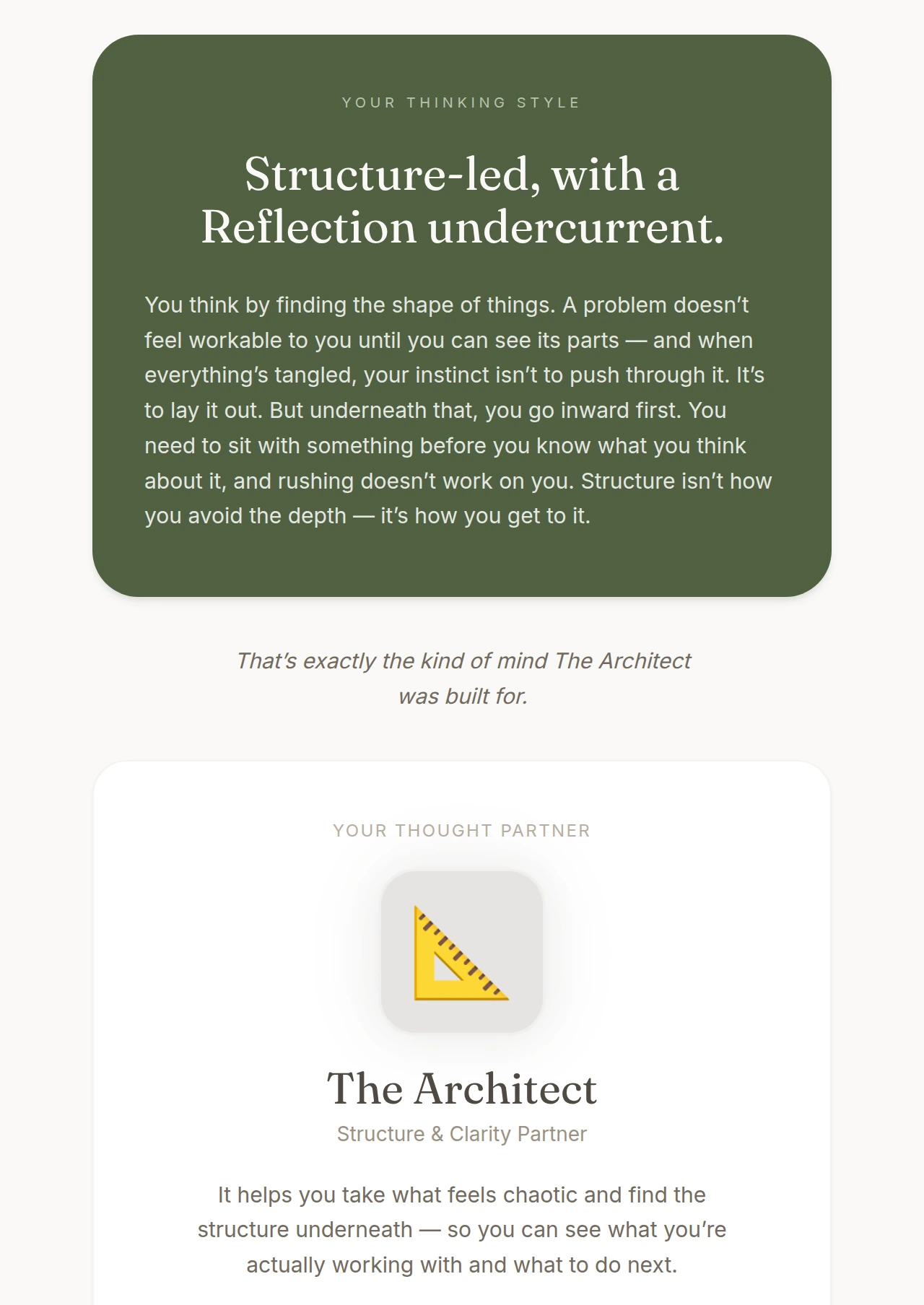
Seven partners. Your answers shape the match.
Some people think better with structure. Others need space, perspective, momentum, or a question that opens something up. Your answers help Kinva choose where the conversation begins.
The Architect
For minds that need to see the pieces laid out.
You might bring
“There’s so much going on, I don’t even know where to start.”
Its first move
Let’s lay it out. What are the pieces, and which one feels the most tangled right now?
Tap through the seven — or start the match to find yours.
About 5 minutes to match · Free during early access
How it works
Match
A few questions about how you think and what actually helps you move. You’ll see why you were matched.
Think
Talk or type about what’s on your mind. Your partner might ask a question, reflect something back, slow the pace, or push.
See
Leave with a clearer view of what you think. Over time, Kinva surfaces the themes that keep returning — without telling you what they mean.
What thinking through actually does
You’re at floor 20. Kinva rides down with you.
Most thoughts start at the surface. This is what it looks like when one of them gets to keep going.
You
“I’ve been offered a bigger role, and I can’t decide whether to take it.”
The question that splits it open
What makes this harder than deciding whether you want the job?
You
“Because it’s a good opportunity. I’m just not sure it’s a direction I actually want.”
The question underneath the question
Which have you been trying to figure out: whether it’s a good opportunity, or whether it’s right for you?
You
“Mostly whether I’d be stupid to turn it down.”
The thing you didn’t know you knew
What would you ask yourself if turning it down didn’t need defending?
Three turns. Twenty floors. This is what we mean by thinking through.
ANOTHER KIND OF THOUGHT
Not every thought that needs working through is a feeling.
You
“I can make a case for all three product directions.”
Thought partner
Before we compare them, what would have to be true for one to be right now — not just the most exciting?
You
“I think I’ve been optimizing for reach when the real constraint is learning speed.”
Thought partner
Then which direction gives you the clearest learning loop without a decision you can’t undo?
Why Kinva
Built to help you think, not think for you.
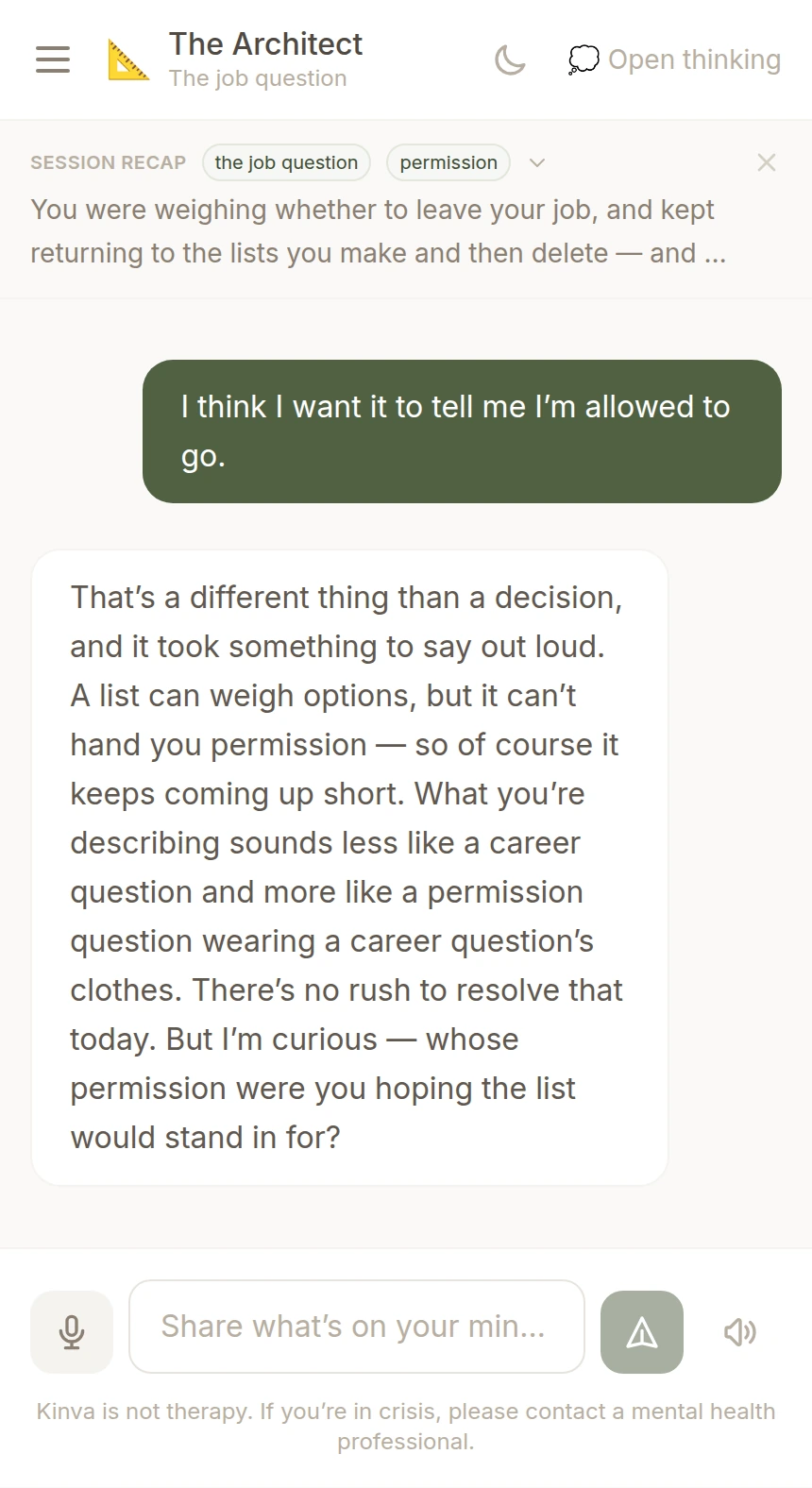
General AI produces. Kinva helps you examine.
Journaling records. Kinva responds and adapts.
Therapy provides clinical care. Kinva is a nonclinical place for everyday thinking.
Companions sustain connection. Kinva is built for clarity and a natural ending.
Over time
One conversation can bring clarity. Over time, you start to see how you think.
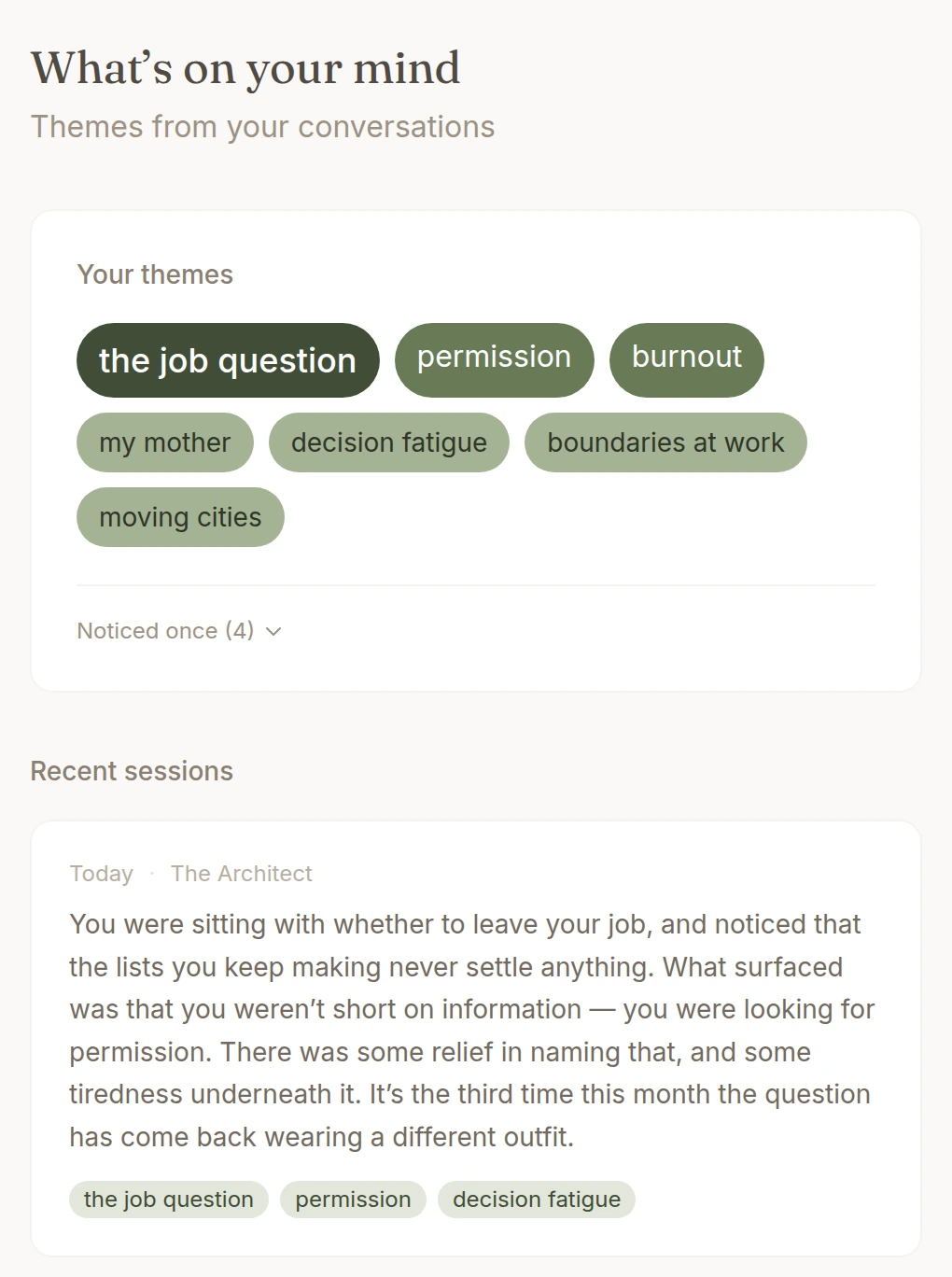
After a few sessions, Kinva surfaces the threads your mind keeps pulling on — without ever telling you what they mean.
What people walk away with
What people leave seeing more clearly.
“I came in spinning. I left with one clear question I could actually sit with.”
“It’s the first time using AI didn’t leave me feeling more scattered. I felt slower in a good way.”
“I started seeing the pattern I keep avoiding. Nobody told me what it was. I just… started seeing it.”
“I came in not knowing how to name what I was feeling. I left able to say it out loud.”
The next time a thought isn’t finished, ride it all the way down.
Clarity you leave with, not an answer you were handed.
About 5 minutes to match · Free during early access
Kinva is a nonclinical thinking tool — not therapy, diagnosis, treatment, or crisis care. See how safety works.